07968 107902 / 07595 120212
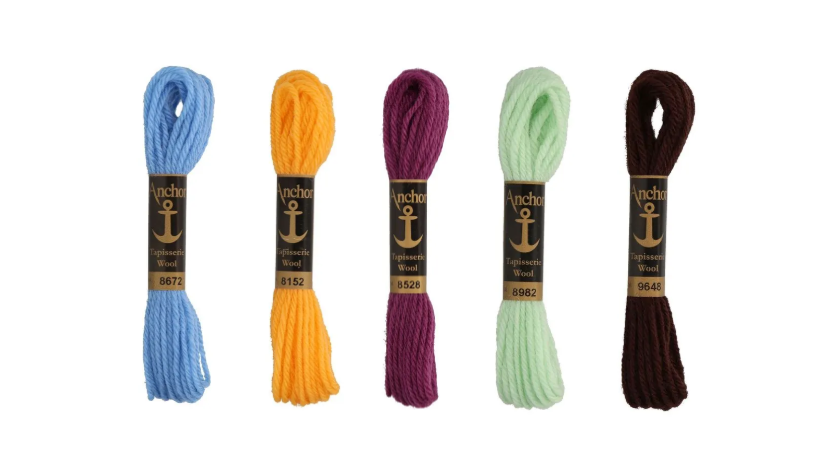
Tapisserie wool is one of the most trusted fibres in the needlepoint world, yet it is often misunderstood by beginners and occasionally underused by more experienced stitchers. If you have ever admired a beautifully worked canvas with smooth, even coverage and rich colour, there is a strong chance that Tapisserie wool played a central role. Understanding how to use it properly can elevate your work from acceptable to exceptional.
At its core, Tapisserie wool is a finely spun, non divisible wool thread specifically designed for needlepoint on canvas. Unlike stranded embroidery floss, it is ready to use straight from the skein and offers consistent thickness throughout. This makes it particularly well-suited to evenweave canvases, where precision and uniform coverage are essential for a professional finish.
For needlepoint enthusiasts who value premium quality materials and top-end craftsmanship, Tapisserie wool by Anchor offers a balance of durability, softness and colour vibrancy. It glides smoothly through canvas, resists excessive pilling, and provides excellent stitch definition. When used correctly, it produces a refined texture that enhances both traditional and contemporary designs.
However, using Tapisserie wool incorrectly can lead to disappointing results. Overworking the thread can cause it to fray, while poor tension or unsuitable canvas pairing may result in patchy coverage or distortion. By learning proper techniques and handling methods, Ajanta Studios can help you avoid these common pitfalls and ensure your needlepoint projects achieve a polished, professional appearance.
Selecting the correct canvas is fundamental when working with Tapisserie wool, as the thread is designed for specific mesh counts. Typically, it performs best on 10 to 14 count canvas, where its thickness provides optimal coverage without bulk. Using a canvas that is too fine may cause overcrowding, while a coarse canvas can leave gaps between stitches. You'll often benefit from pairing premium canvases with high quality wool to achieve consistent results. Taking time to match your materials ensures your finished piece looks balanced and refined.
The needle you choose has a direct impact on how Tapisserie wool behaves as you stitch. A tapestry needle with a blunt tip and an eye large enough to accommodate the wool without abrasion is ideal. Proper handling is equally important, as wool fibres can weaken if repeatedly pulled or twisted. By maintaining a smooth stitching rhythm and avoiding excessive friction, you preserve the integrity of the thread. This results in cleaner stitches and a more professional finish.
Consistent coverage is one of the hallmarks of expert needlepoint, and Tapisserie wool excels when handled with care. Uneven tension can cause stitches to appear irregular or distort the canvas, particularly in larger designs. By maintaining a steady hand and paying attention to stitch direction, you can create a smooth and cohesive surface. This is especially important for decorative pieces where visual impact matters.
Although Tapisserie wool is durable, it can still fray if handled improperly. Frequent rethreading, rough canvas edges, or overly long strands can all contribute to fibre breakdown. Taking preventative measures helps maintain the wool’s smooth texture and colour vibrancy. This kind of attention to detail is perfect for customers who expect long-lasting quality in their finished work.
One of the advantages of Tapisserie wool is its ability to produce rich, subtle colour effects. Skilled stitchers often blend shades or use careful shading techniques to add depth and dimension to their work. This is particularly effective in detailed designs where colour transitions enhance realism. With practice, you can use Tapisserie wool to achieve a sophisticated, "gallery quality" finish.